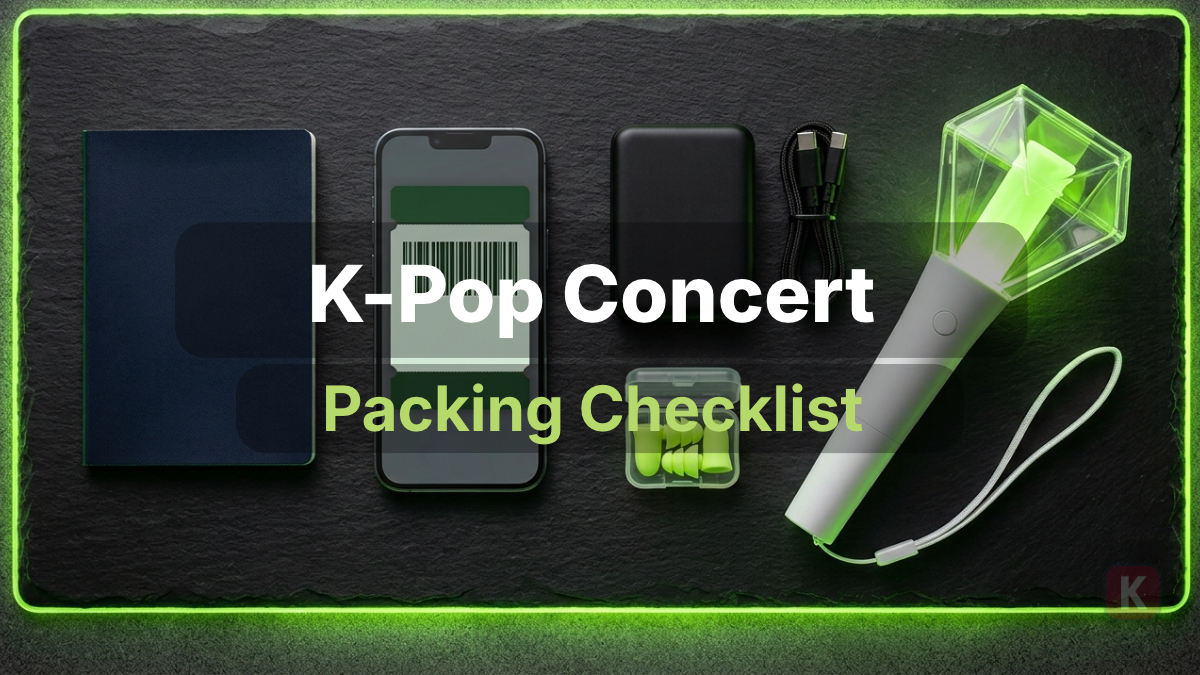
Attending a live performance in Seoul is an unforgettable milestone for any music enthusiast, but knowing what to bring to a K-pop concert in Korea requires much more than tossing a standard travel checklist into a daypack. International fans frequently encounter strict venue security protocols, rigid ticket-booth identification verifications, and unexpected restrictions on digital entry access and personal belongings. Generic internet guides often repeat the same basic items—such as bringing your passport, a portable battery, and an official light stick—while overlooking critical event-specific nuances that can determine whether you breeze through security or find yourself barred at the entry gate.
To ensure a seamless concert day, you must separate absolute essentials from optional comforts and conditional items that depend entirely on your specific venue and promoter notice. Whether you are preparing for a massive stadium show at Gocheok Sky Dome or an arena event at KSPO Dome, this comprehensive, policy-aware packing guide provides the exact operational framework international fans need. Let us dive into the ultimate preparation checklist, detailed decision matrices, and professional strategies designed to safeguard your K-pop concert experience from start to finish.
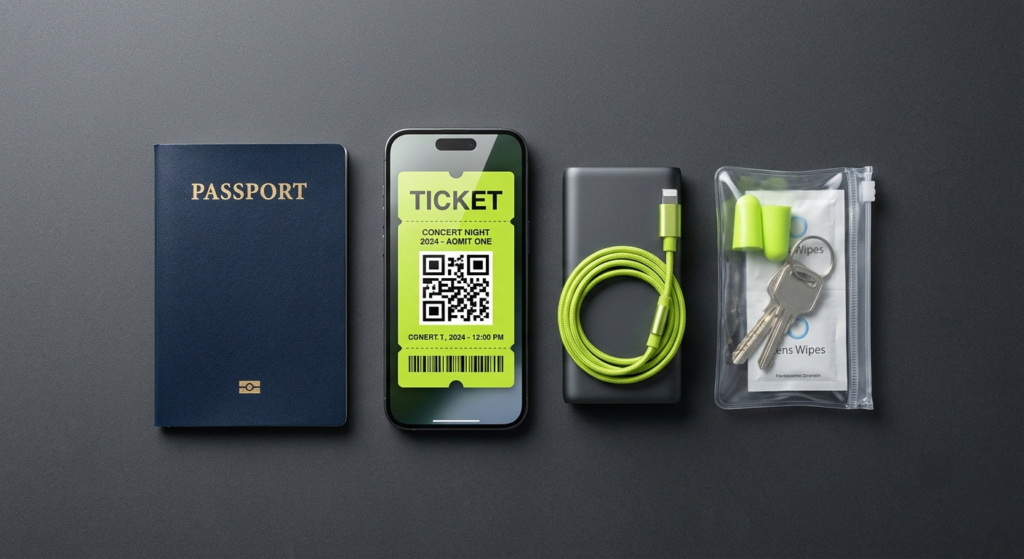
Table of Contents
1. Quick Checklist: Essentials, Optional Extras, and Check-First Items
Navigating the complex operational landscape of Korean concert venues starts with a clear, systematic categorization of your packing inventory. When organizing your belongings for concert day, you cannot afford to treat every item with equal weight. Certain credentials, such as your physical passport and official booking confirmation, are absolute legal and logistical essentials that admit zero compromise under any circumstance. Other items, such as specialized fandom accessories or secondary comfort gear, fall into optional extras that enhance your physical endurance during long hours of queuing outside the venue. Finally, items like specific bag dimensions, beverage containers, and digital ticket formats represent conditional variables that shift depending on the promoter’s operational notice for your exact event.
To help you structure your packing plan efficiently, the decision matrix below outlines how every core item should be classified before you leave your hotel or accommodation. Pay close attention to the status rules: items marked as “Bring (Mandatory)” must be secured regardless of the venue, while items marked as “Check Event Notice” demand immediate verification against the official ticketing portal or promoter announcement. For international travelers navigating unfamiliar venue surroundings in Seoul or Incheon, establishing this structured decision-making approach eliminates cognitive overload and protects you against sudden policy changes enforced by local event staff on-site.
| Item Category | Specific Item Name | Status Classification | Operational Guidance & Restrictions |
|---|---|---|---|
| Identification | Physical Passport | Bring (Mandatory) | Domestic driver’s licenses from your home country are strictly rejected at Korean box offices. Your physical passport matching the booking name is mandatory. |
| Ticketing | Mobile App Ticket / QR | Check Event Notice | Verify whether live app access is required or if specific date-conditioned screenshots are permitted due to venue network congestion. |
| Connectivity | Local eSIM or Pocket Wi-Fi | Bring (Mandatory) | Reliable mobile data via a Korea eSIM for tourists is essential for loading dynamic ticketing apps, digital membership cards, and real-time transit apps. |
| Power | Compact Portable Charger | Bring (Essential) | Long hours standing in queues drain smartphone batteries rapidly. Ensure your power bank complies with standard airline and venue safety capacities. |
| Bag Storage | Small Crossbody or Clear Bag | Check Event Notice | Many Korean venues enforce strict dimension limits or mandate transparent bags. Review official organizer guidelines before selecting your daily carrier. |
| Fandom Gear | Official Light Stick & Fresh Batteries | Optional / Check | Check if Bluetooth pairing or central concert control app registration is required prior to entering the arena bowl for seat sync. |
Furthermore, maintaining an organized packing strategy ensures that you can move swiftly through crowded transit hubs and venue security checkpoints. When traveling from your hotel or utilizing transport networks like the AREX from Incheon Airport, keeping your identification and digital tickets in an easily accessible zipper pocket saves precious time. Do not underestimate the physical demands of a K-pop concert day in Korea; standing in lines for official merchandise, fan-club booth verification, and ticket box office collection can easily exceed four to six hours before the actual auditorium gates open. By categorizing your gear accurately with this matrix, you protect your physical energy and safeguard your entry eligibility.
2. Always Read the Official Notice for Your Exact Event
The single greatest mistake international fans make when preparing for a concert in South Korea is assuming that rules from one event apply universally to all others. Event regulations, ticket collection windows, security screening intensity, and bag size allowances vary significantly between promoters, ticketing agencies (such as Interpark Global, Yes24, and Ticketlink), and specific venue managements. An official notice published by a promoter for a stadium tour in Goyang will often feature entirely different stipulations compared to an arena show in Seoul or an outdoor festival in Incheon. Therefore, treating the official notice as your ultimate operational law is non-negotiable. You must locate, translate, and thoroughly digest the official notice published on your ticketing platform or the artist’s official global fandom hub at least one week before your scheduled performance date.
Passport, Ticket Booking Confirmation, and Membership Proof
When you arrive at the box office for ticket collection or identity verification, your documentation must be completely flawless. For international visitors, your physical passport serves as the primary and frequently exclusive legal proof of identity accepted by event coordinators. Home-country driver’s licenses, national ID cards, state IDs, and photocopies are routinely rejected by box office staff who must cross-reference your booking name with your official government-issued travel document. If you booked your ticket through global booking portals, ensure that the name on your passport matches the reservation profile down to the exact spelling and order of your given and family names. Mismatches caused by middle names or inverted name fields represent the primary reason fans encounter ticket collection disputes.
In addition to your passport, you must carry your printed or digital booking confirmation email, the original credit card used for the purchase (if specified by the ticketing vendor’s will-call policy), and any required fan-club membership verification proof. For specialized fan-club presales, organizers frequently demand proof of active global membership status via the official app (such as Weverse), alongside physical ID matching the membership registration data. Failing to present any one of these layered verification components can result in the complete forfeiture of your ticket without refund or appeal. For detailed strategies on navigating this process, consult our specialized guide on how foreign fans can buy K-pop concert tickets in Korea.
Live Mobile Ticket vs. Screenshot: Know Your Entry Method
Digital ticketing systems in Korea introduce unique technical hurdles for international visitors relying on foreign data roaming or unstable venue Wi-Fi networks. Many modern ticketing platforms utilize dynamic, rotating barcodes or animated security seals designed to prevent screenshot sharing and unauthorized resale. If your event mandates a live mobile ticket loaded directly inside an app like Interpark Global or Weverse, attempting to present a static screenshot will result in immediate rejection at the turnstile scanner. This security measure prevents fraudulent duplication but places immense pressure on your mobile connectivity during peak network congestion outside packed concert arenas.
However, operational rules are not entirely uniform across all performances in South Korea. Official notices occasionally adapt to known infrastructure bottlenecks at massive stadium venues. For instance, historical event notices for specific high-capacity performances—such as a SEVENTEEN Seoul stadium concert—have expressly permitted mobile-ticket screenshots for designated entry gates to mitigate severe cellular network outages caused by tens of thousands of fans attempting to load data simultaneously. Conversely, strict soundcheck procedures, such as those implemented for BTS Goyang events, mandate active app-based QR verification and explicitly prohibit captured images. The golden rule is clear: read your specific event notice to determine whether live app loading or a permitted screenshot is required for your entry route.
3. Venue Regulations: Bags, Water, Cameras, and Storage
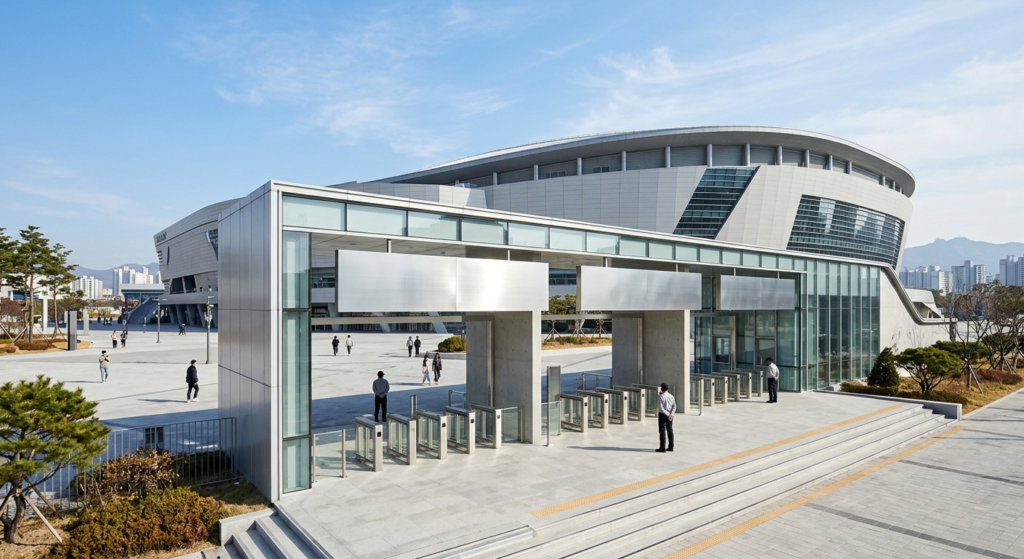
Concert security screening in South Korea is conducted with rigorous efficiency, and security personnel strictly enforce rules regarding personal belongings. Arriving at a venue like KSPO Dome or Gocheok Sky Dome with an oversized backpack, prohibited beverage containers, or professional recording equipment will instantly halt your progress at the security checkpoint. Unlike venues in some Western markets where bag policies are loosely enforced, Korean security staff operate strictly according to the promoter’s published guidelines. Understanding these operational boundaries before you pack ensures that you avoid awkward forced surrenders or lengthy arguments at the security queue.
Navigating Bag Restrictions and A4/Clear Bag Realities
Bag regulations vary widely depending on the promoter and the architectural limitations of the venue. While some indoor arenas permit standard small handbags and cross-body pouches, major stadium events frequently enforce strict dimension caps—such as limiting bags to A4 paper dimensions or requiring transparent clear bags to expedite security screening. Large backpacks, suitcases, shopping bags, and bulky gear carriers are universally prohibited inside the seating bowl. If you are traveling directly from a day of sightseeing or carrying luggage after arriving in Seoul, you cannot bring these items past the security perimeter.
To solve this logistical challenge, you must plan ahead by utilizing official venue lockers, nearby subway station storage facilities, or dedicated concert luggage storage services. Major transport hubs and concert complexes feature electronic lockers, but these fill up hours before showtime as thousands of attendees seek storage solutions. Reviewing specialized resources such as our guide on where to store luggage for a K-pop concert in Korea helps you identify secure, pre-booked storage alternatives, ensuring your personal belongings remain safe while you enjoy the performance without being encumbered by heavy bags.
Hydration, Water Bottle Limits, and Official Storage Uncertainties
Staying hydrated during a high-energy K-pop concert is essential, but venue hydration rules are notoriously restrictive. Most Korean concert venues prohibit outside beverages in colored, opaque, or glass bottles due to safety and littering concerns. Furthermore, open cups, cans, and large commercial bottles are frequently confiscated at security checkpoints. Many venues permit only small, factory-sealed clear plastic water bottles (typically under 500ml), while others mandate that bottle caps be removed and discarded upon entry to prevent bottles from being hurled into the performance area. Always check your event’s specific beverage policy before purchasing drinks outside the gate.
Regarding photography and recording equipment, security policies are uncompromising across South Korea. A common misconception among international fans is that possessing a smartphone permits unrestricted recording. In practice, while bringing your smartphone into the venue is standard, official notices for most K-pop concerts strictly prohibit professional photography, video recording, and audio capturing during the performance. Staff members monitor the crowd with laser pointers and security patrols; violating these rules can result in immediate expulsion from the venue without warning or ticket refund. Leave DSLR cameras, detachable lenses, tripods, and tablet devices locked securely in your hotel room or storage locker.
4. Tech & Gear: Power, Connectivity, and Light-Stick Preparation
Technology plays a central role in the modern K-pop concert experience, from digital tickets and fan community verification to interactive light-stick synchronization. However, relying on digital tools inside a packed stadium creates significant technical vulnerabilities. Cellular networks experience massive throttling when tens of thousands of devices simultaneously connect to local transmission towers. To safeguard your connectivity, ensure you have activated a high-performance data plan, such as a reliable Korea eSIM for tourists, before heading to the venue. Avoid depending entirely on public Wi-Fi networks, which frequently collapse under heavy traffic loads outside concert arenas.
Power management is another critical priority for concertgoers in Korea. Between navigating Seoul via Naver Map and KakaoMap, capturing pre-show memories, loading digital tickets, and coordinating with friends after the show, your smartphone battery will drain at an accelerated rate. Packing a compact, airline-approved portable power bank (along with certified charging cables) is essential. Furthermore, if you are bringing an official fandom light stick, preparation must begin the night before the show. Replace old batteries with fresh AAA alkaline cells to ensure optimal brightness, and update your light stick firmware using the official artist companion app. For detailed pairing instructions, consult our expert guide on K-pop light stick pairing in Korea: setup checklist.
5. Seated, Standing, and Outdoor Concert Packing Variants
Your packing checklist must adapt dynamically to your seating category and environmental conditions. Attending an indoor seated concert in a climate-controlled arena requires a different preparation strategy compared to standing in a packed floor pit or enduring an open-air stadium show during harsh weather seasons. For floor standing sections, your primary enemies are physical fatigue, dehydration, and crushing crowd pressure. In these zones, you should minimize your carried items to an absolute bare minimum: secure clothing with deep zippered pockets, a lightweight cross-body pouch, comfortable supportive footwear, and earplugs to protect your hearing against high-decibel sound systems.
Outdoor and seasonal concerts in Korea demand additional weather-proofing measures. If your concert takes place during the scorching Korean summer months, pack portable handheld electric fans, cooling wet wipes, UV-blocking sunglasses, and high-SPF sunscreen. Conversely, spring and autumn evening performances in Seoul can experience sharp temperature drops once the sun sets, making a lightweight, packable jacket essential. If rain is forecasted, remember that most Korean venues strictly prohibit traditional long umbrellas inside the seating bowl due to obstructed sightlines and safety hazards; instead, pack a compact, disposable rain poncho purchased locally at a convenience store.
6. Final Pre-Departure Hotel Check
On the day of the concert, execution precision is everything. Before you step out of your hotel room or shared accommodation, execute a final, systematic pre-departure audit of your belongings. Stand by the door and verify each item against your physical checklist. This final ritual eliminates the devastating realization—halfway across Seoul on the subway—that you left your passport in the hotel room safe or forgot your concert ticket QR code on your tablet.
Your pre-departure checklist should confirm the following items are secured in your pockets or small bag:
- Physical Passport: Verified against your booking confirmation name and stored in an easily accessible zipper pocket.
- Ticket Access Method: Live app logged in with stable data connection, or official printed confirmation / permitted screenshot.
- Payment Readiness: Credit cards and transport cards (such as WOWPASS or NAMANE) loaded with sufficient funds for transit and merchandise.
- Portable Power: Fully charged power bank and connection cable.
- Health & Personal Care: Personal medications, tissues, wet wipes, and authorized hydration items.
Once your final check is complete, review your transit route using reliable local navigation apps. Understanding how to use Naver Map and KakaoMap in English in Korea ensures that you select the fastest subway or bus routes, avoiding unexpected transit delays caused by heavy pre-concert traffic congestion around major stadiums across the city.
7. Troubleshooting: What to Do If Something Goes Wrong at Entry
Even with meticulous planning, unforeseen complications can arise at the concert venue entry gate. Technical glitches, data network dropouts, identity discrepancies, or misplaced booking credentials can instantly trigger panic. The most important rule when encountering an entry barrier is to remain calm and seek authorized assistance immediately rather than arguing with security volunteers who operate under strict language and operational constraints.
If your mobile ticketing app fails to load due to network congestion, step away from the immediate crush of the turnstiles to an area with clearer cellular signal, or request temporary assistance from venue Wi-Fi help desks if available. If your ticket collection is flagged due to a name mismatch or an unreadable passport, proceed directly to the designated International Help Desk or Box Office Will-Call window, where English-speaking ticketing representatives can verify your purchase using your original booking confirmation email and credit card. Knowing where official support desks are located within the venue perimeter prevents confusion and gives you the best possible chance of resolving entry disputes before the show starts.
8. Printable Event-Policy Worksheet & Quick FAQ
To ensure absolute preparedness, use the template below to record your event-specific details. You can copy this worksheet into your notes app or print it out to keep with your travel documents before arriving at the venue.
| Worksheet Field | Your Event Details (Fill In) |
|---|---|
| Artist & Concert Title | [e.g., World Tour in Seoul] |
| Show Date & Time | [e.g., October 28, 2026 at 18:00 KST] |
| Venue Name | [e.g., KSPO Dome / Gocheok Sky Dome] |
| Official Notice URL | [Paste official promoter announcement link] |
| Accepted Identification | [Physical Passport confirmed] |
| Ticket Access Method | [Live App QR / Will-Call Booth Pickup] |
| Bag & Water Restrictions | [Max A4 size, sealed 500ml water only] |
| Last Verification Date | [Date you checked the final notice] |
Frequently Asked Questions
Q: Can I use my home-country driver’s license as identity proof at a K-pop concert in Korea?
A: No. Korean ticketing box offices strictly require your physical passport for international ticket collection and identity verification. Driver’s licenses from outside South Korea are not accepted.
Q: Are screenshots of mobile tickets accepted for venue entry?
A: In most cases, static screenshots are rejected because dynamic barcodes require live app loading. However, always check your exact event notice, as rare performance-specific exceptions have occasionally permitted screenshots during severe network outages.
Q: What should I do if my light stick is not pairing with the venue’s central control system?
A: Ensure you have installed fresh AAA alkaline batteries and updated your light stick firmware using the official artist companion app prior to entering the venue auditorium.