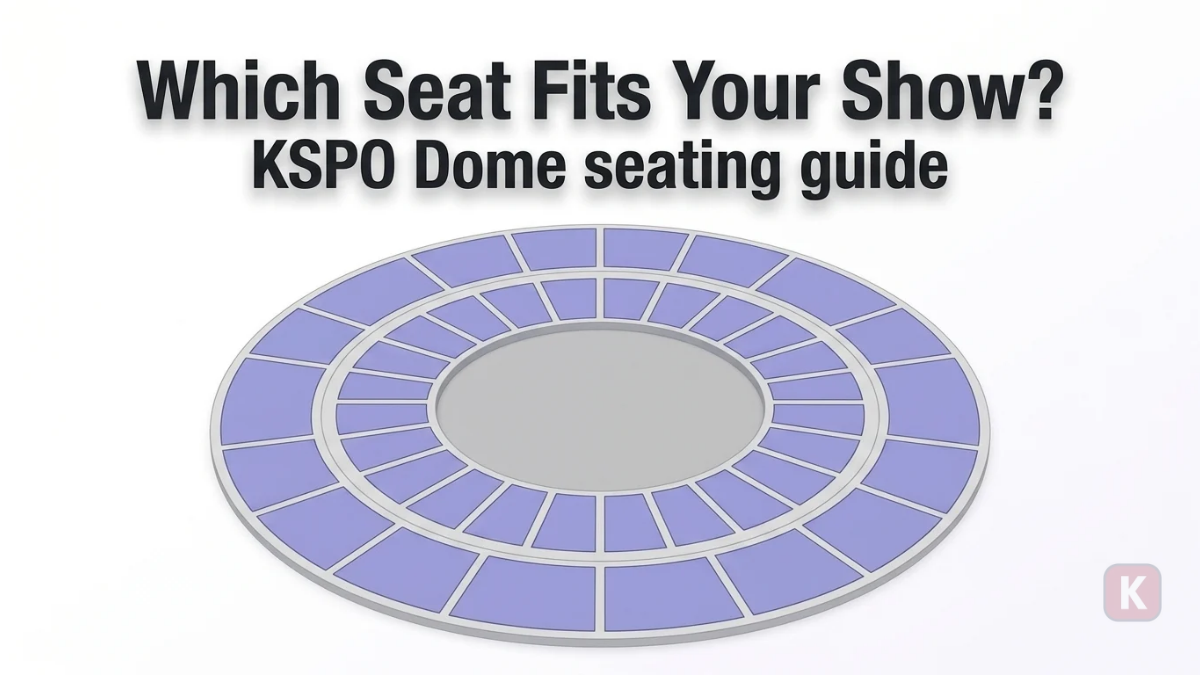
This KSPO Dome seating guide explains how the arena’s permanent seating is laid out, how to read a concert seat map, and what international fans should confirm with the organizer before buying or attending. KSPO Dome, also known as the Olympic Gymnastics Arena (올림픽체조경기장), sits inside Olympic Park at 424 Olympic-ro, Songpa-gu, Seoul. The Korea Tourism Organization describes it as the arena built for gymnastics at the 1988 Seoul Summer Olympics and later remodeled to host concerts. The venue operator publishes a general seating chart, but the stage position, ticket grades, available seats and entry details change from one concert to the next, so this guide separates what is fixed about the building from what you must check for your own show.
Table of Contents
1. Understanding the KSPO Dome Seating Layout
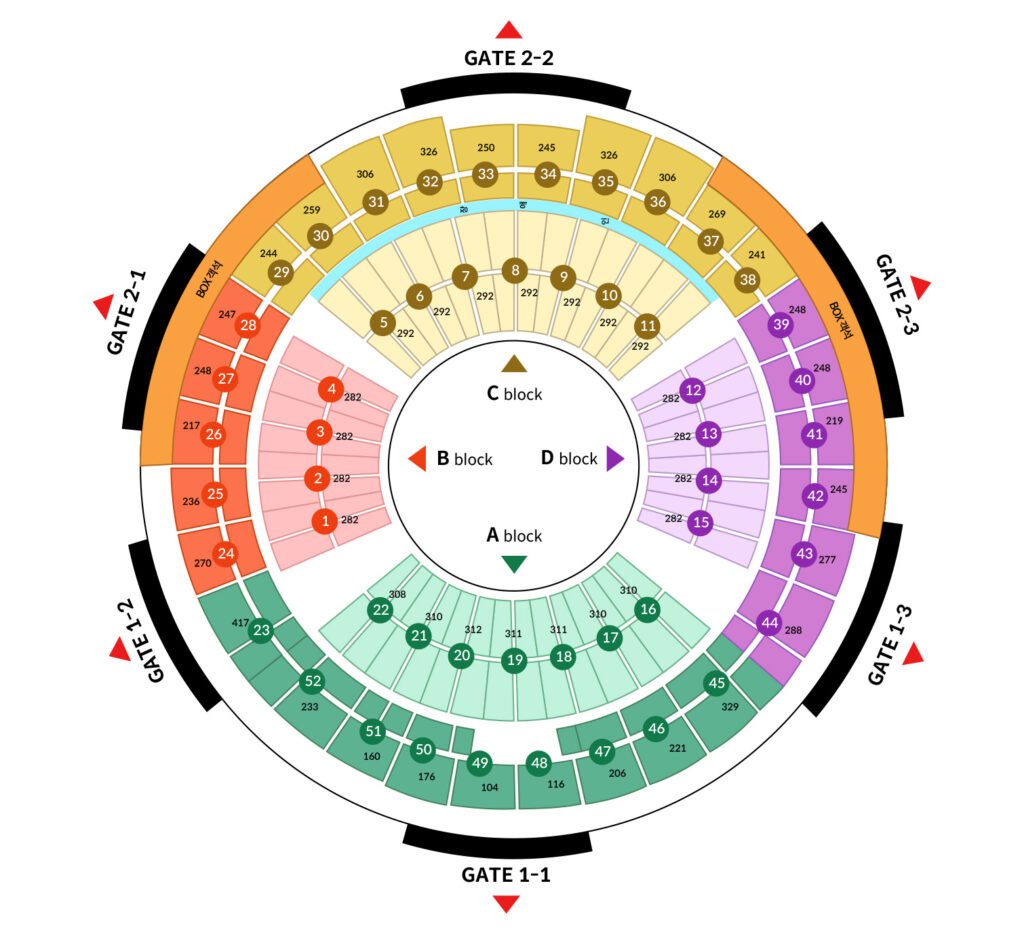
According to the venue operator’s facility overview, KSPO Dome is a circular arena with a basement level and three levels above ground. Its seating chart describes a Floor on the first level and numbered seating sections on the second and third levels. Sections run clockwise around the bowl, and the sections are grouped into four lettered blocks: A, B, C and D. That chart shows the permanent building. It does not show where the stage will stand for your concert.
1F Floor: Seated or Standing?
The official chart labels the first level simply “Floor.” The venue describes itself as a multipurpose space with retractable seating, which is why the floor can be arranged differently from event to event. Depending on the production, the Floor may be seated, standing, or partly taken up by stage, camera or control areas. Never assume that a floor ticket for one concert tells you how the floor will work for another. The organizer’s notice and the ticketing page for your exact date are the places to confirm it.
2F Sections 1–22
The second level is the lower fixed tier that surrounds the floor. Its sections are numbered 1 through 22 and split across blocks B, C, D and A, as shown in the table below. Which of these sections face the stage, sit at the side, or end up behind it depends entirely on the concert’s stage design.
3F Sections 23–52 and Box Seats
The third level is the upper fixed tier, numbered 23 through 52. Because it sits above the lower tier, views from here are higher and farther from the stage. The operator’s chart also lists box seats in 3F sections 26–30 and 37–42. Whether those box seats are sold for a particular concert, and at what ticket grade, is an event decision, not a fixed feature of the venue.
| Level and block | Section numbers |
|---|---|
| 2F, Block B | 1–4 |
| 2F, Block C | 5–11 |
| 2F, Block D | 12–15 |
| 2F, Block A | 16–22 |
| 3F, Block B | 24–28 |
| 3F, Block C | 29–38 |
| 3F, Block D | 39–44 |
| 3F, Block A | 23 and 45–52 |
2. How to Read a KSPO Dome Concert Seat Map
Understanding Blocks and Section Numbers
The venue’s general chart and the seat map on a ticketing page are two different documents. The general chart is the building’s permanent plan. The ticketing page shows only the seats an organizer has put on sale, and it may group or label areas in its own way. The same section number can sit directly in front of the stage at one concert and at the side of it at another, so always compare section numbers against the stage diagram for your specific show rather than against a general impression of the venue.
Finding the Stage and Your Entrance Gate
The general chart does not mark a stage. For concerts, look for the stage drawing in the organizer’s notice or on the ticketing page. The venue does list six numbered gates, with positions described by clock face around the bowl, and the table below summarizes them. Treat the clock positions as a rough orientation only. Whether your ticket assigns a particular gate is an event-specific detail, and the sources used for this guide do not state any rule that sends ticket holders to a specific gate, so follow your event notice and the signs on site.
| Gate | Position on the bowl (official description) |
|---|---|
| Gate 1-1 | Block A, 6 o’clock |
| Gate 1-2 | Between blocks A and B, 7 o’clock |
| Gate 1-3 | Between blocks A and D, 5 o’clock |
| Gate 2-1 | Between blocks B and C, 10 o’clock |
| Gate 2-2 | Block D, 12 o’clock |
| Gate 2-3 | Between blocks C and D, 2 o’clock |
Korean Seating Terms You May See
Seat maps and notices on Korean ticketing pages may use Korean seating vocabulary. The words below are ordinary Korean terms, not venue rules, and which of them appear on your event’s page depends on the platform and the organizer.
| Korean term | Meaning |
|---|---|
| 지정석 (jijeong-seok) | Assigned (reserved) seat |
| 스탠딩 (standing) | Standing area |
| 시야제한석 (siya-jehan-seok) | Restricted-view seat |
| 돌출무대 (dolchul-mudae) | Extended stage that juts out from the main stage |
| 본무대 (bon-mudae) | Main stage |
| 열 (yeol) / 번 (beon) | Row / seat number |
Checking Restricted-View and Production Areas
Concert production can take seats off sale. Camera platforms, sound and lighting control positions, extended stages and other production areas may block or remove sections that look perfectly normal on the general chart, and the venue does not publish one universal concert-day seat map. If a ticketing page flags a seat as restricted view or marks an area as a production hold, read that note before you buy. Do not assume a restricted-view seat comes with a price reduction or a particular kind of obstruction, because neither is established for the venue as a whole.
3. How to Choose Seats for Your Concert
Check the Stage Layout Before Comparing Seats
Start with the stage, not the section number. A stage built at one end, a stage in the center of the floor, and a stage with long runways all turn the same circular bowl into very different seating plans. Once you know where the stage stands, you can judge how close, how central or how angled a section is for your show. No section is “best” for K-pop in general, and nothing in the venue’s official information supports ranking sections, rows or distances in advance.
Understand What the Official Seat Map Can and Cannot Tell You
The general chart can tell you which tier a section belongs to, which block it is in, and roughly where gates and box seats are located. It cannot tell you the stage position, how the floor is arranged, which seats are held back for production, or how a given ticket category such as VIP, R, S or A maps onto physical sections. Those categories are commonly used for concerts, but the mapping and any benefits attached to them are set for each event. Check the ticket page or organizer notice for your concert before treating a category label as a promise about location.
4. Ticketing and Entry: What International Fans Should Check
Ticket sales, identity checks, ticket pickup and entry procedures are handled by the organizer and the ticketing platform for each event, not by the venue’s general seating page. The sources used for this guide do not state whether a passport, a Korean phone number, a particular ID document or a specific payment card is required, so this guide does not say either way. Use the checklist below, and read your own event’s notice for the answers.
| # | Action | Done |
|---|---|---|
| 1 | Find the seating map the organizer or ticketing page published for your exact concert date, not only the venue’s general chart. | ☐ |
| 2 | Confirm the stage location and whether the floor is seated or standing for your show. | ☐ |
| 3 | Read any restricted-view warnings and production-area notes before you pay. | ☐ |
| 4 | Check which physical sections your ticket grade covers and what benefits, if any, the event lists for it. | ☐ |
| 5 | Find the entry gate, ID requirements and ticket pickup instructions in the event notice or on the ticketing page. | ☐ |
| 6 | Check current transit information for getting there and getting home after the show. | ☐ |
If you have not bought your ticket yet, our guide for foreign fans buying K-pop concert tickets in Korea covers the purchase side. If your concert is sold through NOL World, the NOL World K-pop ticketing guide is the better companion. For light stick setup before the show, see our K-pop light stick pairing checklist.
5. Getting to KSPO Dome
The nearest station is Olympic Park Station, served by Seoul Subway Lines 5 and 9. The venue operator’s directions page names Exit 3. A travel guide published by the ticketing and travel platform NOL World (Interpark Global), which is a platform guide rather than the venue’s own page, describes a walk from Exit 4 past a thumb sculpture, with the dome on your right and roughly seven minutes on foot. The two sources name different exits, so follow the signs and your map app on the day. Our guide to using Naver Map and KakaoMap in English can help with that. The same NOL World guide adds that on Line 5 you should board a train toward Macheon because the line splits, which fits Wikipedia’s station table placing Olympic Park on the Line 5 Macheon branch, and that both express and regular Line 9 trains stop at Olympic Park Station.
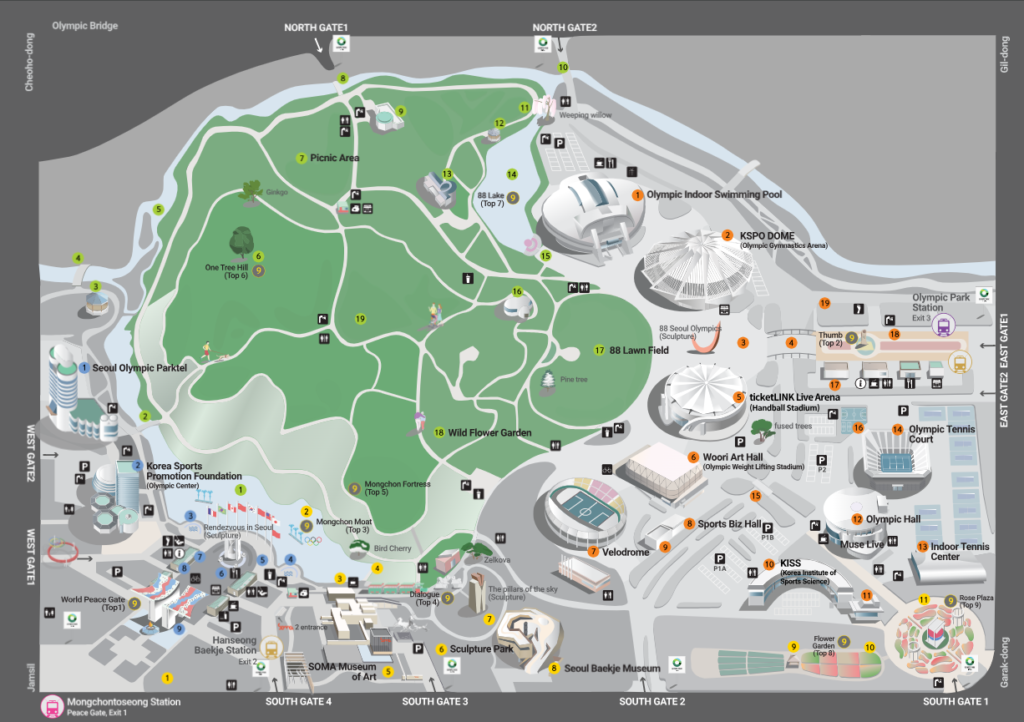
Bus route numbers listed by the venue and by the NOL World guide are not identical, so confirm routes in a current map app. After a concert, the NOL World guide notes that the taxi queue in front of Olympic Park Station can be long and traffic congested, and it names Hanseong Baekje Station (Line 9) and Mongchontoseong Station (Line 8) as alternatives about a 20-minute walk away. Last-train times, fares and any extra late-night service change, so check the operator’s current timetable for your date. If you arrive with bags, see our guide to storing luggage for a K-pop concert in Korea.
Driving is possible but worth checking in advance. The venue’s parking page names lot P5 as the nearest lot, with 181 spaces and opening hours of 06:00 to 22:00, and it does not say whether rules or fees change on concert days. Confirm parking details in your event notice before you plan around a car.
6. KSPO Dome Seating FAQ
How many people does KSPO Dome hold?
The venue operator gives two figures: 15,000 seats in its facility summary and 14,594 people at one time in its descriptive text. The Korea Tourism Organization’s VISITKOREA listing also shows a maximum capacity of 15,000. Neither number is a ticket count for a concert, because production areas and the stage can reduce what is actually sold.
Can I see the venue before choosing a seat?
The venue’s KSPO Dome page links to a 3D seating chart and a 360-degree VR tour, which are useful for getting a feel for the building. They show the venue in general, not the stage setup or floor arrangement of your concert.
Where is wheelchair-accessible seating?
The venue’s seating chart notes wheelchair-accessible seating behind the 2F C block. Availability and booking steps are decided for each event, so ask the organizer or ticketing platform listed on your concert’s notice.
7. Sources and Official Links
- KSPO DOME facility overview and seating chart (Olympic Park, KSPO&CO; in Korean)
- Olympic Park directions (KSPO&CO; in Korean)
- Olympic Park parking information (KSPO&CO; in Korean)
- KSPO Dome listing (Korea Tourism Organization, VISITKOREA)
- KSPO DOME venue guide (NOL World travel guide; a platform guide, not the venue’s own page)
- Olympic Park station (Wikipedia; background on the Line 5 and Line 9 services)
Last reviewed: October 16, 2026