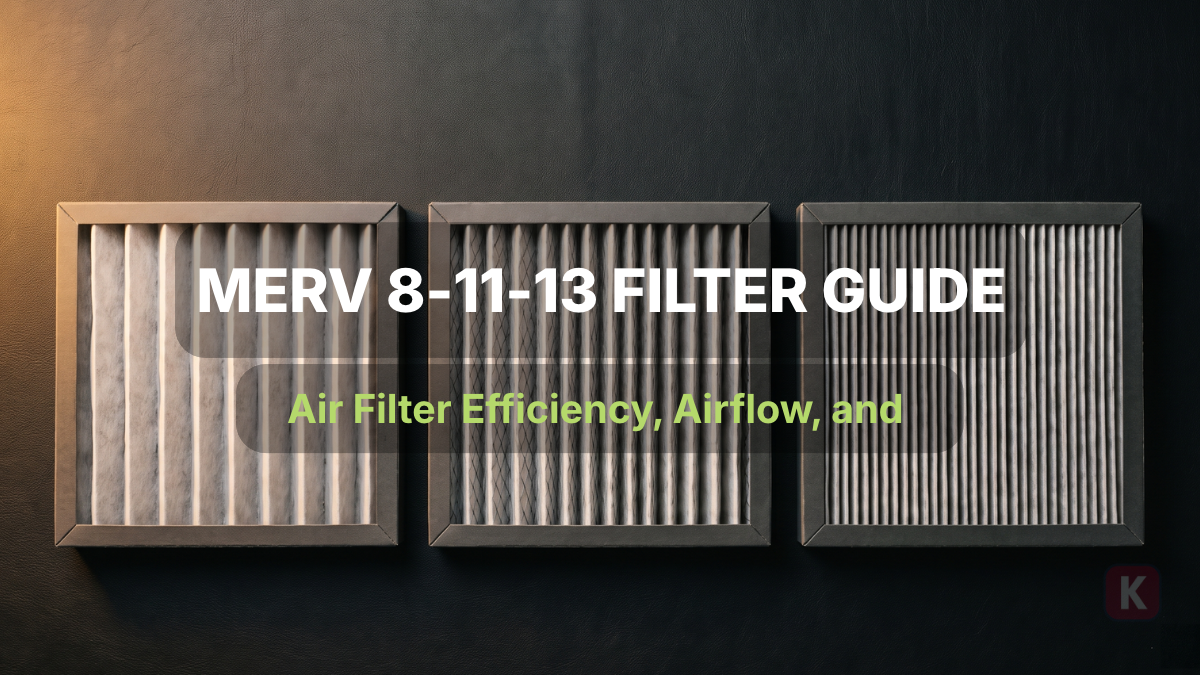
MERV 8 vs MERV 11 vs MERV 13 comes down to how much fine particulate matter each filter captures across the 0.3-to-10-micron range that the ASHRAE 52.2 test method measures, with MERV 13 the lowest rating required to capture at least 50% of the smallest 0.3-to-1.0-micron particles, according to the U.S. EPA. Jumping straight to the highest printed number without checking your filter slot depth, frame fit, or blower capacity can raise static pressure, restrict airflow, or simply let air leak around a poorly seated filter. This guide breaks down the official EPA and ASHRAE 52.2 minimum efficiency bands, the airflow-resistance mechanics behind higher-efficiency media, and a three-variable Selection Fit Matrix to help you identify the highest MERV rating your residential forced-air system can realistically support.
Quick answer
- MERV 8 handles basic coarse-particle capture (at least 70% at 3.0–10.0 microns; no specified floor at 0.3–1.0 microns), MERV 11 adds an entry-level fine-particle floor (at least 20% at 0.3–1.0 microns), and MERV 13 meets the EPA fine-particle benchmark most commonly recommended for residential upgrades (at least 50% at 0.3–1.0 microns and 85% at 1.0–3.0 microns).
- Minimum particle-capture bands come from the ASHRAE 52.2 test method as published in the U.S. EPA’s What is a MERV rating? guidance.
- Higher efficiency can raise pressure drop, reduce airflow, or increase fan energy use, and a MERV number reflects a lab-tested minimum, not guaranteed as-installed performance if air bypasses a poorly fitted frame.
- Measure your filter slot depth and frame dimensions, confirm blower capacity with an HVAC technician if your system is older or unverified, and replace filters every 60 to 90 days, or sooner if heavily soiled.
How MERV Ratings Measure Particle Capture (MERV 8 vs MERV 11 vs MERV 13)
The ASHRAE 52.2 Test Basis and the 0.3–10 Micron Scale
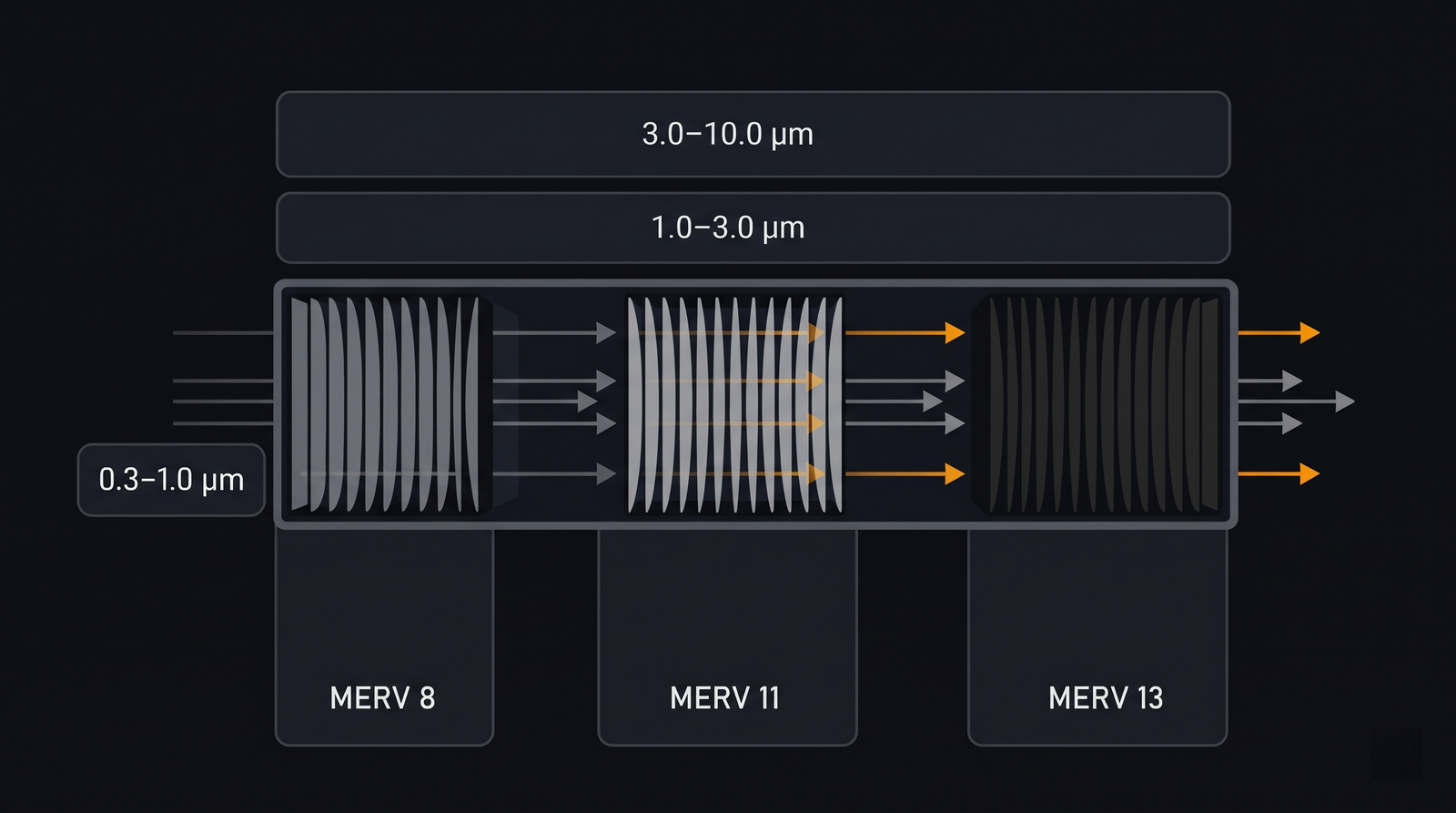
The Minimum Efficiency Reporting Value is a single number derived from the ANSI/ASHRAE 52.2 test method, which measures how much of an airborne particle stream a filter captures as the particles pass through three defined micron bands: 3.0 to 10.0 microns (coarse dust and larger pollen), 1.0 to 3.0 microns (mold spores and pet dander), and 0.3 to 1.0 microns (fine combustion particles and some bacteria-sized material). The test reports a minimum capture percentage for each band the filter qualifies in, and the overall MERV number is simply the lowest rating tier the filter’s worst-performing band still satisfies.
Minimum Efficiency Thresholds Compared
Moving from MERV 8 to MERV 11 adds a formally reported floor for the 0.3-to-1.0-micron band for the first time. The U.S. EPA’s published table lists no specified minimum for MERV 8 in that smallest band, only the coarser 1.0-to-3.0 and 3.0-to-10.0 ranges. MERV 11 closes that gap at a modest level, while MERV 13 raises every band at once, most notably the fine-particle floor that EPA treats as the baseline for upgrading a residential filter. Table 1 below lists the exact minimum percentages EPA publishes for MERV 8, 11, and 13; the rest of this section explains what the numbers mean rather than repeating them in prose.
| MERV Rating | 0.3–1.0 µm Minimum Capture | 1.0–3.0 µm Minimum Capture | 3.0–10.0 µm Minimum Capture | Standard Role & Target Scope |
|---|---|---|---|---|
| MERV 8 | Not specified in EPA table | ≥ 20% | ≥ 70% | Baseline coarse-particle capture; lowest baseline threshold among the three |
| MERV 11 | ≥ 20% | ≥ 65% | ≥ 85% | Mid-tier step-up; first tier with a specified 0.3–1.0 µm minimum floor |
| MERV 13 | ≥ 50% | ≥ 85% | ≥ 90% | EPA’s most commonly recommended residential target, when fan and filter slot can accommodate it |
All percentages are ASHRAE 52.2 test-derived minimum composite efficiencies reported by the U.S. EPA; they describe laboratory test minimums, not a guaranteed result for every installed unit.
Why a MERV Number Is a Minimum Floor, Not a Real-World Guarantee
It is worth being precise about what a MERV number actually certifies. ASHRAE’s own standard interpretation describes MERV as a reporting value calculated from laboratory test data, not a statistical guarantee that every unit of that filter will perform identically once installed in a home. A correctly built MERV 13 filter can test above its published floor, but installation conditions, such as fit, face velocity, and how loaded the media already is, can also pull delivered performance below the number printed on the filter frame. The rating tells you the test-qualifying minimum under controlled lab conditions; it does not by itself tell you how the filter will behave in your specific duct and blower combination.
Airflow Resistance, Pressure Drop, and Why MERV Alone Does Not Tell the Whole Story
How Higher Efficiency Affects Pressure Drop and Fan Energy Use
A higher MERV rating generally means denser or more electrostatically active filter media, and denser media resists airflow more than coarser media does. ASHRAE’s filtration guidance states plainly that increasing filter efficiency can increase pressure drop, which in turn can reduce airflow through the system or force the blower to work harder and draw more energy to compensate. None of this means a MERV 13 filter is automatically wrong for a given home; it means the efficiency number alone does not describe how much resistance a specific filter adds to a specific system.
Filter Depth, Media Area, and Dust Loading Variables
Two filters can carry the same MERV rating and still have very different pressure drops, because resistance depends on filter depth, pleat count, total media surface area, and the face velocity the air moves through the media. A deep 4-to-5-inch (about 102–127 mm) pleated cabinet filter typically spreads the same required media area over a larger surface than a thin 1-inch (about 25 mm) filter, which generally lowers face velocity and resistance for an equivalent efficiency tier. This is why no single pressure-drop figure can be quoted for “a MERV 13 filter” in general; the number is tied to the exact product’s depth, pleat design, and the blower’s own static-pressure capability, none of which the MERV rating reports.
Can Most Residential Furnaces and HVAC Systems Use MERV 13?
EPA states that most furnaces and HVAC systems can accommodate a MERV 13 filter without creating equipment problems, provided the filter is replaced frequently so it does not load up and add resistance on top of its baseline design. Because home HVAC systems are rarely labeled with a maximum MERV rating, EPA recommends consulting a professional HVAC technician when you are not certain your blower and filter slot can absorb the added resistance of a higher-efficiency filter, particularly in an older system or a narrow 1-inch slot.
MERV Selection Fit Matrix: Matching Filter Rating to Your HVAC System
How to Read the Three-Variable Selection Matrix
Choosing among MERV 8, 11, and 13 is really a three-variable decision: how deep your filter slot is, whether your system’s airflow capacity has actually been confirmed, and what level of particle control you are trying to achieve. Table 2 below crosses these three variables into a starting recommendation for four common scenarios, from a shallow 1-inch slot on an unverified older system to a 4-to-5-inch media cabinet on a confirmed modern blower. Use the matrix as a starting point for the conversation with a technician, not as a substitute for checking your own equipment.
| Filter Slot Depth (Imperial / Metric) | HVAC Airflow Capacity Status | Primary Filtration Objective | Recommended Starting Path & Verification Rule |
|---|---|---|---|
| 1 in (~25 mm) slot | Unknown / unverified older system | Basic equipment protection / coarse dust | Start at MERV 8 or MERV 11; verify fan and static-pressure tolerance with an HVAC technician before moving to MERV 13. |
| 1 in (~25 mm) slot | Confirmed compatible or modern blower | Maximum fine-particle capture | Use MERV 13 only with a snug, non-crushed fit and a strict 60–90 day (or sooner) replacement schedule. |
| 2 in (~51 mm) slot | Standard / verified residential capacity | Balanced fine-particle upgrade | MERV 11 or MERV 13; the deeper media area helps manage resistance relative to a 1-inch frame, subject to manufacturer specs. |
| 4–5 in (~102–127 mm) media cabinet | Confirmed compatible system | Highest EPA-recommended residential target | Target MERV 13 if the cabinet and manual permit; maintain a snug seal and follow the manufacturer’s replacement schedule. |
Five-Point HVAC Filter Compatibility Checklist
“Confirmed” airflow capacity in the matrix above means a technician, the furnace or air handler manual, or the filter rack’s own labeling has actually stated what efficiency or resistance level the blower can handle, not that the system has simply run without obvious problems for a while. An older, unverified system can run quietly for years on a low-resistance MERV 8 filter while still being unable to absorb the added resistance of a MERV 13 upgrade, because reduced airflow from a restrictive filter does not always announce itself as a loud symptom; it can instead show up gradually as a shorter equipment lifespan, a warmer-than-expected supply register, or higher energy bills. Starting at the matrix row that matches your actual, verified slot depth and capacity status is lower-risk than starting from the MERV number you would prefer to use and working backward.
| # | Compatibility Check | Priority |
|---|---|---|
| 1 | Verify the filter’s actual (not just nominal) dimensions against the frame opening. | Required |
| 2 | Never bend or crush the filter to force it into the slot. | Required |
| 3 | Confirm a snug, gap-free seal on every edge of the frame. | Required |
| 4 | Replace on a 60–90 day cadence, sooner if the filter looks heavily soiled. | Required |
| 5 | Consult an HVAC technician if your blower’s static-pressure capacity is unverified. | Recommended |
Installation Fit, Air Bypass, and Maintenance Limits That Control Real Performance
Preventing Air Bypass and Navigating Nominal vs. Actual Filter Sizes
A filter’s printed MERV rating only describes what happens to the air that actually passes through the media. If the filter does not seat snugly in its frame, air finds the path of least resistance and leaks around the edges instead of through the pleats, which means some portion of the air entering your ducts was never filtered at all, regardless of whether the filter is rated MERV 8 or MERV 13. EPA’s installation guidance is direct on this point: filters should fit snugly so air does not leak around them, and they should never be bent or crushed to force a fit, since a bent filter can both compromise the seal and shorten the media’s service life.
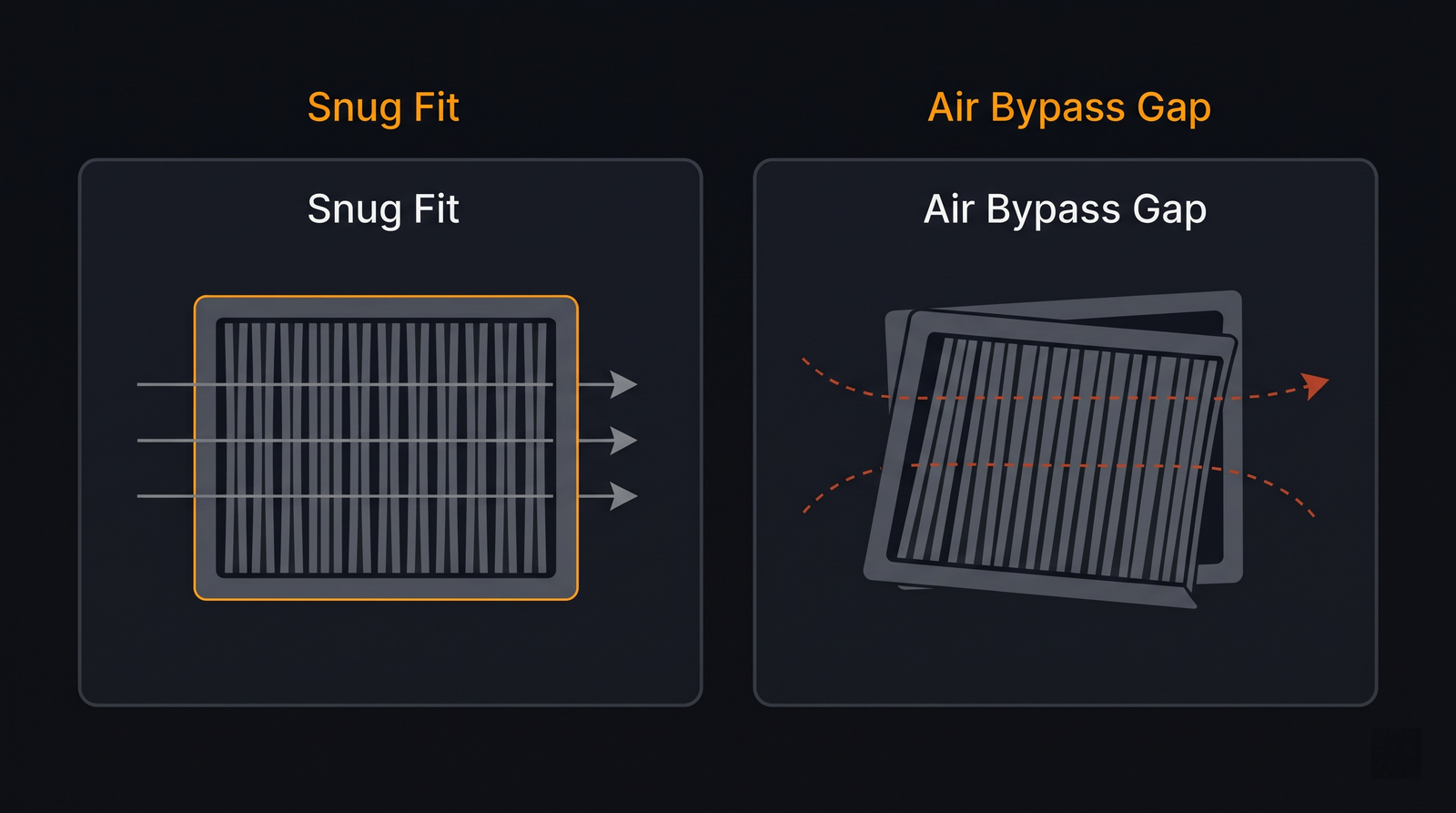
Filter sizing adds a second, often overlooked complication for global readers. U.S. residential filters are commonly labeled with nominal inch dimensions, such as 16 by 25 by 1 inch, but the filter’s actual measured dimensions are typically slightly smaller to allow it to slide into the frame; many markets outside North America instead label filters with exact millimeter dimensions. Either way, check the frame opening itself rather than assuming a printed nominal size will fit, especially when replacing a filter in an unfamiliar system or importing a filter sized for a different regional standard.
Replacement Intervals, Heavy Dust Loads, and System Runtime Tradeoffs
All filters, regardless of rating, need regular replacement to keep performing as tested. Manufacturers commonly recommend replacing residential filters every 60 to 90 days, and EPA notes that a filter showing heavy soiling at replacement time should be changed more often going forward. Dust load, pets, local outdoor particle events, and how many hours the system runs all shorten that interval in practice. Because HVAC filters only remove particles while the blower is actually moving air, and systems commonly run less than about 25% of the time during a heating or cooling season, extending runtime to filter more air also raises electricity use and can reduce the system’s ability to control indoor humidity, a tradeoff worth weighing before deciding to run a system continuously for air-quality reasons alone.
Frequently Asked Questions About MERV 8, MERV 11, and MERV 13 Filters
How do MERV ratings compare to store-brand FPR and MPR numbers?
MERV is a national consensus rating derived from the ASHRAE 52.2 test method, while FPR (Filter Performance Rating) and MPR (Microparticle Performance Rating) are proprietary rating systems created by individual retailers and manufacturers. A proprietary FPR or MPR number does not map 1:1 onto the MERV scale, so check the packaging or manufacturer specification sheet for an explicit ASHRAE-based MERV rating before comparing two filters across brands.
Is a MERV 13 filter considered a HEPA filter?
No. MERV ratings apply to standard HVAC particle filtration tested under ASHRAE 52.2, while HEPA (high-efficiency particulate air) performance is defined separately and is not based on the MERV rating system, according to the EPA. A HEPA filter’s minimum capture efficiency is substantially higher than MERV 13 and is typically found in portable air cleaners rather than standard furnace filter slots.
Can MERV 11 or MERV 13 filters remove odors, VOCs, or stop household mold?
No. Standard MERV-rated filters are designed to capture airborne particles, not gases, odors, or volatile organic compounds, which require a separate sorbent medium such as activated carbon. Air filtration also does not resolve the underlying moisture source that causes mold growth; the EPA advises addressing the moisture problem directly rather than relying on filtration to solve it.
Is MERV 13 required by residential building codes?
Not universally. Ventilation and filtration requirements vary by country and by locally adopted building code, and the EPA’s MERV 13 guidance is performance advice conditioned on system compatibility, not a blanket residential code mandate. Check your local jurisdiction’s adopted code if you need a definitive answer for a specific permit or inspection.
Sources
- U.S. EPA – What is a MERV rating?
- U.S. EPA – Guide to Air Cleaners in the Home
- ASHRAE – Filtration and Disinfection FAQ
- ASHRAE – Standard 52.2 Interpretation IC 52.2-1999-5
Last reviewed: November 22, 2026